 0
0
 0
0
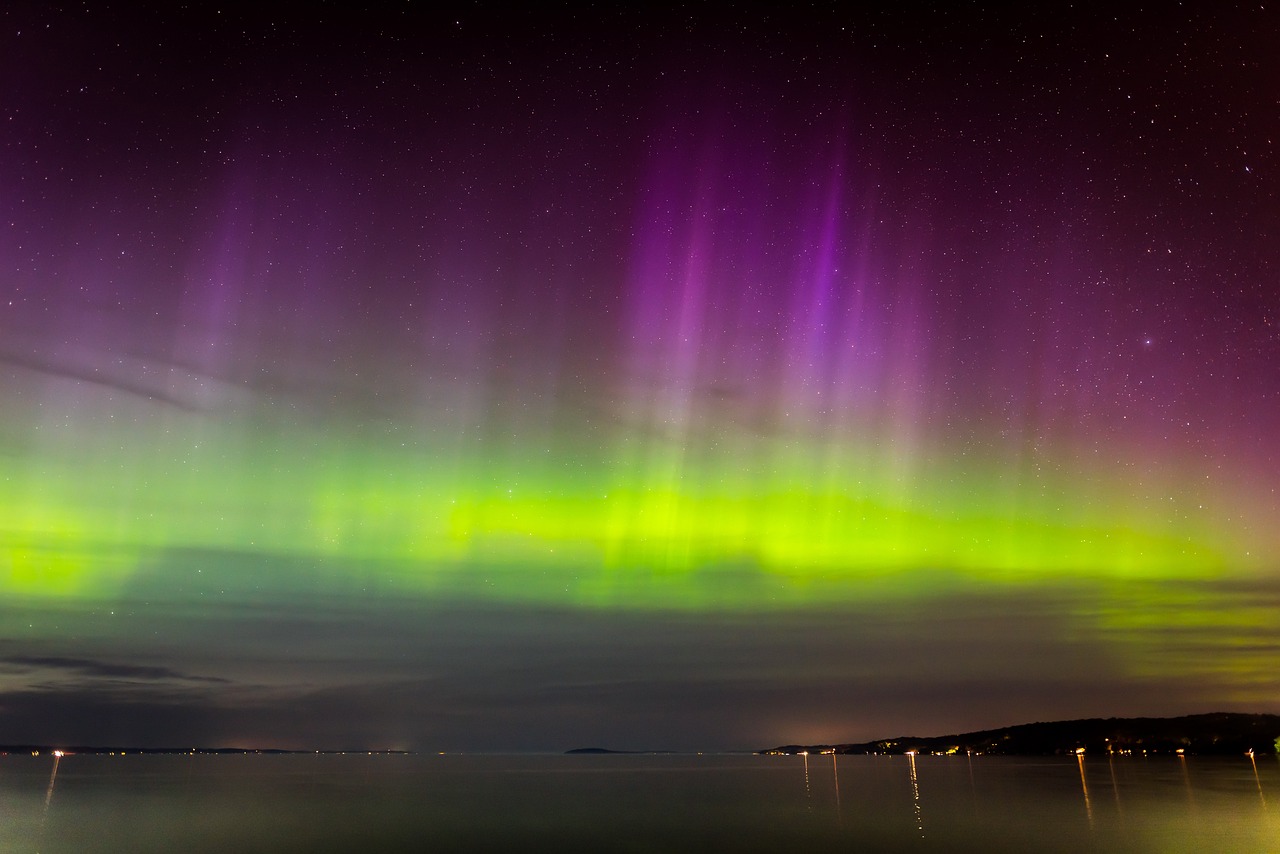
Despite the Sun gradually moving toward its next activity minimum, scientists still see a realistic chance of auroras being visible from Austria in 2026. According to space‑weather researcher Christian Möstl of the Austrian Space Weather Office at GeoSphere Austria, three to five geomagnetic storms strong enough to trigger auroras over Central Europe are expected next year. If weather conditions cooperate, this could translate into one or two opportunities to witness the aurora borealis from Austrian skies.
Solar Activity Declining After 2024 Peak
The Sun reached the maximum of its current roughly 11‑year activity cycle in 2024 and is now entering its declining phase. Solar activity is measured by counting sunspots, which are used to calculate the “sunspot relative number.” This value indicates how magnetically active the Sun is and allows comparisons with previous solar cycles.
In 2024, 49 solar storms struck Earth’s magnetic field. Up to 35 are expected by the end of 2025, and between 20 and 30 are forecast for 2026. As the cycle moves toward its predicted minimum around 2030, the number of storms will continue to decrease.
However, Möstl and his colleague Eva Weiler emphasize that the declining phase often produces fewer but stronger solar storms—events capable of generating intense geomagnetic disturbances, visible auroras, or even technical disruptions.
Why Central Europe Mostly Sees the “Red Aurora”
For auroras to appear over Central Europe, several conditions must align:
- the geomagnetic storm must be strong enough,
- its peak must occur during nighttime,
- and skies must be clear.
This was the case during the most recent aurora visible in Austria on the night of 12 November. Even then, the so‑called “auroral oval”—the region around the poles where the familiar green aurora is typically visible overhead—did not extend far enough south to reach Central Europe.
“When we observe auroras here, it is usually the ‘red aurora,’ caused by collisions between oxygen atoms and high‑energy particles from Earth’s magnetic field at altitudes above 300 kilometers,” Weiler explained. The well‑known green aurora, by contrast, forms around 100 kilometers above the surface.
Seven Strong Geomagnetic Storms in 2025
In 2025, seven geomagnetic storms had the potential to produce auroras over Central Europe. During two of them—one in January and one in November—weather conditions across much of Austria allowed successful observations. The November 12 storm was the third‑strongest of the current solar cycle.
For 2026, experts expect three to five storms capable of generating auroras at Austria’s latitude. “If the weather cooperates, there could be one or two more opportunities to see auroras here before the Sun enters its next activity minimum around 2030,” Möstl said.
Solar Storms Also Cause Technical Disruptions
Solar storms do not only create spectacular night‑sky displays—they can also interfere with technology. The strong storm on 12 November caused radio communication and satellite navigation disturbances across Europe, Africa, and Asia.
A separate incident on 30 October involving an Airbus A320‑family aircraft has also drawn attention. Although initially attributed to “solar radiation,” researchers note that no significant solar eruptions occurred that day. Möstl suggests that a high‑energy particle from cosmic radiation is the more likely cause, though solar particles can trigger similar issues.
New Satellites Aim to Improve Space‑Weather Forecasting
Given the growing importance of space‑weather prediction, several international missions are underway.
- In March, NASA launched the PUNCH mission, a fleet of four satellites that has already delivered early images of solar storms and the solar wind.
- In September, NOAA launched the SWFO‑L1 mission to the Lagrange Point 1 between Earth and the Sun. Equipped with electronics developed by the Space Research Institute (IWF) of the Austrian Academy of Sciences, the satellite is designed to provide early warnings of solar storms.
The upcoming solar minimum around 2030 is also being used to prepare for the next activity cycle. At its ministerial conference in late November, the European Space Agency (ESA) advanced several missions into the planning stage, including spacecraft that would continuously image the auroral oval from Earth orbit. Another project, the SHIELD mission, envisions a fleet of small satellites orbiting Earth at wide distances to extend warning times for incoming solar storms—though such capabilities are not expected before the next solar maximum in the late 2030s.
- source: https://swap.geosphere.at/index.php/at/; Austrian Space Weather Office: https://helioforecast.space/)/picture: pixabay.com



This post has already been read 18651 times!